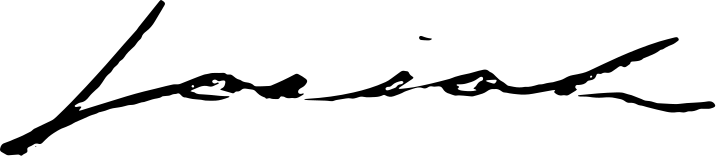
A Visual Refresh: My 2026 Mid-Year Rebrand
For several years, my personal brand was represented by a single avatar — a photograph of the New York City skyline. It was a choice that felt right at the time, but one I grew increasingly uncomfortable with. It didn't communicate who I was, what I built, or what I stood for. Over time, the cracks became harder to ignore:
- My online identity lacked distinctiveness and failed to convey professionalism.
- It was difficult for others to recognize or remember my presence across platforms.
- Opportunities to build a consistent personal brand were limited or missed entirely.
The decision to overhaul everything — brand, site, and blog — wasn't impulsive. It was the result of years of quietly knowing something needed to change.
Branding
I'm particular about design. Especially when it concerns my own name. I knew from the outset that the identity work needed to be handled by someone with genuine experience in professional-grade branding — not a logo generator, not a quick Figma exploration, and certainly not random shapes beside my name with no associative value at a glance.
The goal was something that would read immediately as intentional: a mark that travels well across contexts, scales cleanly, and doesn't require explanation.
Moving to Next.js
My previous site was redesigned in November 2020. Looking back, it was cluttered, difficult to navigate, and overwhelming at a glance. Bounce rates reflected that. People weren't staying long enough to understand what I actually do.
This redesign had a single objective: make it immediately clear who I am and what I offer. Specifically —
- What I do as a Software Engineer and Entrepreneur
- My projects, portfolio, and skillset
- How to get in touch
Next.js was the right call. It gave me the flexibility to build exactly what I had in mind without the overhead of a traditional CMS, while keeping performance and static generation at the center of the architecture.
Redesigned Blog System
I'd been on Ghost for a long time. It served its purpose, but syntax highlighting was always a friction point — sharing code snippets cleanly was harder than it should have been, and the separation between my site and my CMS meant managing two platforms, two deployments, and two billing cycles.
Moving to a markdown-based blog powered by MDX and Prism solved all of that. Posts live in the same repository as the rest of the site, syntax highlighting works out of the box, and everything deploys together through Vercel. One less droplet to maintain. One less thing to think about.
The result is a setup that's faster to write in, easier to maintain, and more consistent to read.